

New Zealand now has clear evidence that living roofs can deliver significant environmental benefits in urban environments.
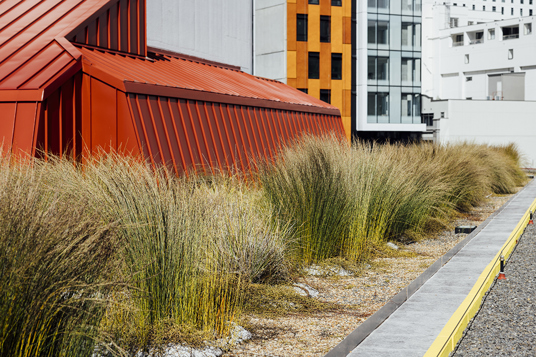
Monitoring of Auckland City Library's 800m² living roof has shown it can reduce stormwater runoff by nearly 80 per cent while keeping roof surface temperatures dramatically lower during summer. The project is providing valuable local data and practical lessons for the future of green infrastructure in Aotearoa.
From roof repairs to a living roof
When Auckland City Library began planning essential roof repairs several years ago, the project team saw an opportunity to do more than simply replace the existing membrane. Instead, they incorporated a living roof system designed to provide environmental benefits while generating valuable New Zealand-specific performance data.
Today, the 1,000m² roof has become a useful case study for the roofing industry, council planners and sustainability researchers.
For RANZ member Allco Waterproofing Solutions, whose Hydrotech membrane supports the system beneath the planting, the project highlighted the importance of quality waterproofing in living roof construction.
"What made Auckland City Library's living roof project so significant for us at Allco was the opportunity to provide a roof garden that sets an example for other businesses and councils going forward," says Allco Product Specialist Chris Ross.
Design and construction
The living roof was designed by Babbage Consultants, with planting supplied and installed by Natural Habitats Limited. More than 2,000 native plants were grown by Ngāti Whātua Ōrākei, who also developed the planting layout inspired by traditional weaving patterns that reflect learning, progress and connection.
Because the library roof has virtually no fall, robust waterproofing was critical. Allco's Hydrotech membrane was selected to provide a durable foundation beneath the living roof system.
"The project reinforces the value of getting the fundamentals right," says Ross. "We are proud to have worked on this project and to demonstrate how robust waterproofing and thoughtful detailing can unlock long-term environmental value in an urban setting."
What the monitoring shows
Since its installation in 2022, the roof has been monitored through a collaboration between Auckland Council and the University of Auckland.
Auckland Council Senior Healthy Waters Specialist Rachel Devine says the local data has been particularly valuable.
"Living roofs have become increasingly common in cities throughout the world for numerous reasons, including their ability to reduce stormwater runoff, improve air quality, protect the roof membrane from solar damage, and increase biodiversity. But obtaining the local data has brought the project alive for us."
Stormwater performance
Monitoring has shown the living roof reduces stormwater runoff by nearly 80 per cent in most rainfall events. During lighter rainfall, almost all water is retained by the planting substrate before reaching the drainage layer.
For a city where stormwater systems are often under pressure during heavy rain, the results provide strong evidence for the value of nature-based infrastructure.
Temperature performance
Thermal monitoring has also demonstrated substantial cooling benefits. On hot summer days, planted sections of the roof recorded surface temperatures up to 56 per cent lower than conventional roofing surfaces.
The cooler temperatures help reduce heat build-up and contribute to improved urban heat management.
Lessons for the future
Maintenance observations have shown that plant performance varies depending on exposure to wind, sun and shade. Hardier species have proven most resilient in exposed areas, while sheltered sections of the roof have required minimal intervention.
Devine says these practical learnings highlight the importance of species selection and understanding local microclimates when designing living roofs in New Zealand conditions.
Opportunities for the roofing industry
While living roofs remain relatively uncommon in New Zealand, Devine believes there is significant opportunity for the roofing industry to play a greater role in their adoption.
"New Zealand is in its nascent stage when it comes to living roofs. Therefore, I think it's beneficial for all facets of the roofing industry to become more upskilled in this area and to understand where there is potential applicability and opportunity for living roof installations."
She says the key is considering living roof opportunities early in the design process, allowing structure, drainage, access and planting loads to be incorporated from the outset.
A roof with a bigger role to play
Three years on, the Auckland City Library living roof has proven its environmental value while providing practical lessons in installation, maintenance and performance.
As Auckland Council continues to explore opportunities for living roofs across the city, the project is helping build the evidence base for future green infrastructure projects.
For the roofing industry, it offers a glimpse of how roofs can contribute not only to weatherproofing buildings, but also to the resilience, sustainability and liveability of New Zealand's urban environments.
This article was originally published in the Summer 2025 issue of RoofLink magazine.